
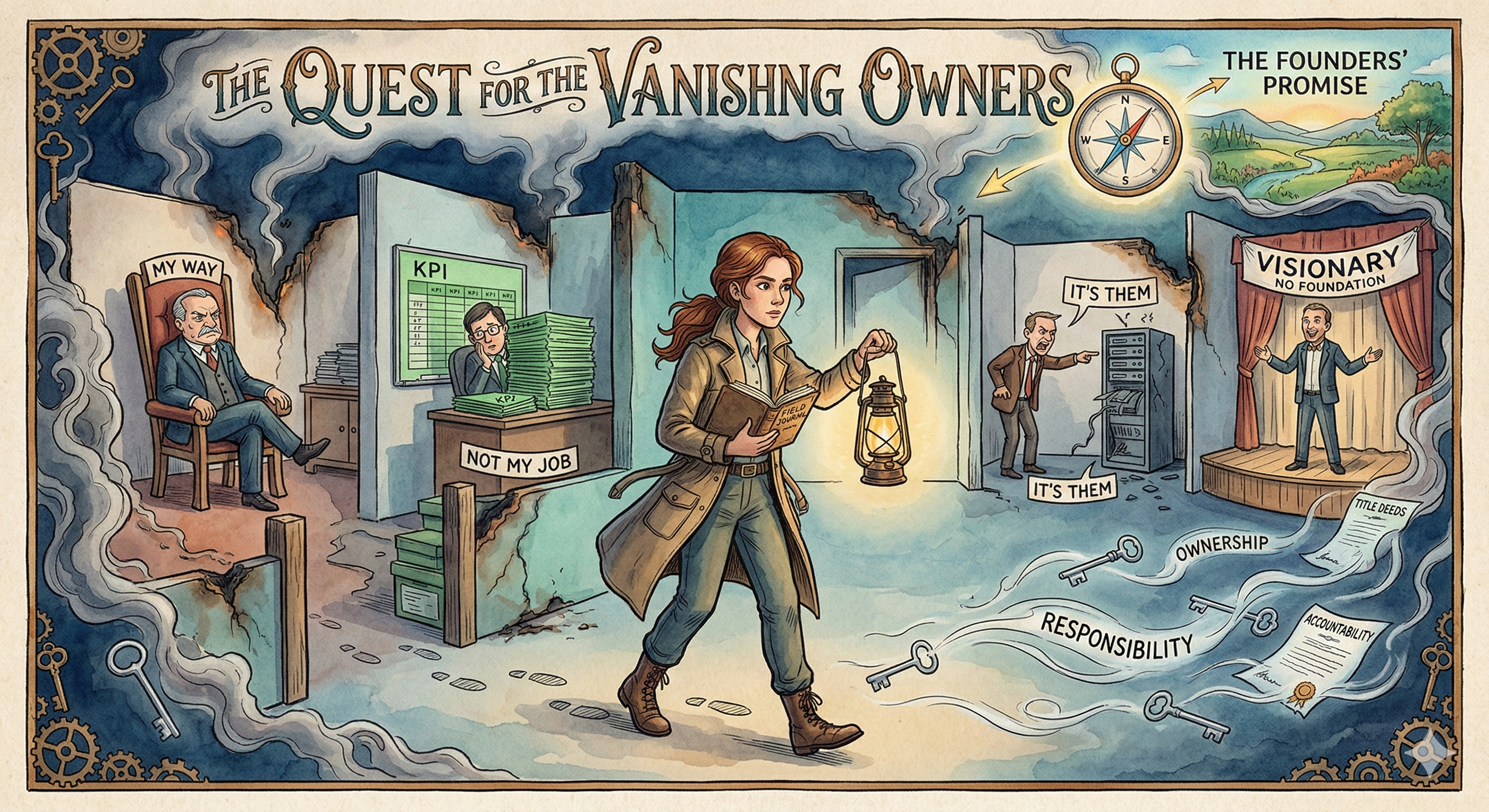
– From The Series of Serious Corporate Mysteries
“Fire! Fire!”
“Run!”
“Do Something!”
The voices of three hundred souls echoed through the atrium of Ignis-Nexus as the unthinkable happened. What began as a minor thermal event in a secondary server rack had cascaded into a catastrophic, company-wide blaze.
Josefine, a forensic investigator of corporate culture, was brought in to understand why it had all happened – and who was responsible. She stood in the scorched lobby weeks later, the smell of charred furniture still clinging to the air. The physical fire was out, but the corporate fire was just beginning. The smoke hadn’t even cleared before the finger-pointing began. The numbers were brutal: a 15% wipeout of projected revenue, a 40-point tanking of the NPS score, and an 18% collapse in share price.
Investors weren’t just fleeing the loss; they were fleeing the silence. As Josefine moved through the wreckage, she noticed something chilling. Some employees had stayed trapped in their “Nexus Boxes”—sleek, glass-walled offices where they watched the flames from a distance, unable to control the fire, yet unwilling to escape their designated “jurisdiction.”
Josefine wasn’t here to find the spark. She was here to find the Owners. In a giant of 30,000 people, surely someone felt responsible for the safety of the hearth?
That question led her on a wild goose chase where every finger pointed at someone else, and every “Owner” vanished into the smoke.
The Investigation: Meeting the Vanishing Owners
As Josefine moved through the charred remains, she encountered the “Non-Owners”—talented professionals who had perfected the art of the “Collective Shrug.”
1. The Charismatic Visionary (The Pseudo-Owner)
First, she met Sunil. He was brilliant, looking truly pained as he surveyed the melted servers he had designed. “It’s a tragedy,” he lamented in his spotlessly clean office. “I built this infrastructure to change the world. But I’m a ‘big picture’ guy, Josefine. I can’t be expected to monitor cooling vents; that’s for the tactical teams.”
The Science: Sunil was a victim of Strategic Decoupling. Research in Administrative Science Quarterly shows that leaders often divorce their “visionary” identity from operational realities to protect their ego from failure. They own the “win,” but disown the “wiring.”
2. The Diligent Specialist (The Silo-Architect)
Next was Louise. Her spreadsheets were pristine, untouched by the soot. “My logs are perfect,” she told Josefine, pointing to a green cell. “I reported the temperature rise to Maintenance via the proper portal. Once that email left my outbox, the fire was no longer in my jurisdiction.”
The Science: This is Functional Parochialism. When organizations over-specialize, employees lose their Line of Sight to the end goal. Louise didn’t see a “potential fire”; she saw a “completed task.”
The 2024 Parallel: In the Boeing 737 MAX door plug incident, the NTSB found that fragmented documentation meant no one “owned” verifying the final bolts. Like Louise, everyone was “in the green” on their specific task while the product was structurally failing.

3. The Autocrat: “My Way or the High Way”
Dave, the Head of Operations, viewed accountability as a top-down extraction. “I gave them the KPIs,” he barked. “If they aren’t ‘owning’ it, they aren’t listening.”
The Science: Defensive Silence. High-control environments cause employees to follow orders into a ditch just to prove the leader wrong. Helicopter leaders don’t build trust; they build “compliant ghosts.”
4. The Blamer: The Defensive Survivalist
When Josefine met Rita from Marketing she got a calm response. “My deck is green. If Engineering is red, that’s their failure.”
The Science: In-group/Out-group Bias. A 2023 study showed that teams with high in-group bias are 60% less likely to share critical data with other departments.
5. The Popular Manager (The Escapist)
Finally, Josefine met Martin, a manager everyone loved. “I didn’t want to burn them out by nagging them about safety protocols,” he shrugged. “We have a culture of trust here.”
The Science: Permissive Leadership. Josefine realized Martin had mistaken a “Comfort Zone” for a “Psychological Safety Zone.” As Amy Edmondson notes, true safety must be balanced with high standards. Without that balance, you don’t get a “happy team”; you get a “comfortable catastrophe.”
The Science: Why Ownership Vanishes
Josefine realized that ownership at Ignis-Nexus didn’t just disappear; it was actively repelled by the company’s “immune system.”
- The Bystander Effect: In large groups, the tendency to assume “someone else will do it” increases. When everyone is responsible, nobody is.
- The Absence of EPO: Employee Psychological Ownership (EPO) is the intrinsic feeling that a project is “mine” to protect. A 2024 study in Evidence-based HRM shows that a lack of EPO is the leading indicator for Knowledge Hiding—the primary reason the early warnings at Ignis-Nexus were ignored.
- Psychological Contract Breach: Data from Gartner (2025) reveals that 76% of high-potential employees “check out” when they feel the company has stopped investing in their growth. They stop “owning” the company because the company stopped “owning” them.

The Solution: From “Renters” to “Owners”
Josefine proposed four “Restorative Rites” to turn “Renters” back into “Owners” and protect/prepare the company to handle different types of “fires”.
- Line of Sight: Replace departmental KPIs with Outcome-Based Metrics. Meta-analysis of 105 studies shows “Task Significance” increases productivity by 26%.
- Radical Transparency: Implement Open-Book Management. Sharing project data leads to an average 19% improvement in profitability.
- Alignment of Quests: Shift to Growth-Goal Alignment. EPO thrives when the organization is seen as a vehicle for an employee’s self-efficacy.
- Cultural Integrity: Define “Behavioral Guardrails.” Research by Cameron & Quinn shows strategic ambitions fail 70% of the time if the unspoken culture rewards opposite behavior.
The Verdict
As Josefine looked back at the glass towers of Ignis-Nexus, the answer was clear. The “Owners” hadn’t been stolen; they were right there, masquerading as “Renters.”
People don’t wash rental cars. They don’t benefit from the shine, and they don’t suffer from the rust. To bring the owners back, leaders must hand over the keys and the title deed to the mission.
The mystery of the vanishing owners wasn’t a “Who-Done-It”—it was a “How-We-Led-It.” The downfall of a giant rarely starts with an explosion; it starts with a collective shrug. The Quest isn’t about finding a culprit; it’s about finding the courage to say, “The fire is mine, or rather, ours to put out.” Which reminds me, I better go and wash our car this time!
- In your team, is accountability a “baton” that gets passed, or a “shield” everyone holds together?
- Do your “Big Picture” visionaries know the critical deliverables and risks that could cause disturbing disruption in the company?
- What elements of your unspoken culture currently support—or sabotage—accountability?
- Keeping in mind your cultural definition, what kind of leader are you becoming, and what evidence do you have that it’s working?
I’d love to hear your thoughts. Let’s start the conversation.

Rajkarn Kaur Anand is a global leadership strategist with over 20 years of experience driving transformation at organizations like Maersk and Novo Nordisk. As a veteran of both Fortune 500 giants and agile start-ups, she specializes in bridging the gap between behavioral science and the balance sheet to solve the “people mysteries” that block company growth.
Raj is a firm believer that organizational health is a fiduciary duty and is dedicated to helping leaders move from “Capability Debt” to a future-ready Growth Mindset.
Connect with Raj on LinkedIn to explore how to effectively strategize and execute a Culture that enables achievement of Company Goals.
Research & References
- Rapti, A., Rayton, B., & Yalabik, Z. (2024). Employee psychological ownership and work attitudes. Evidence-based HRM, 12(1), 1-18. Link
- Edmondson, A. C. (2018). The Fearless Organization. Wiley. Link
- Hackman, J. R., & Oldham, G. R. (1976). Motivation through the design of work. Organizational Behavior and Human Performance, 16(2), 250-279. Link
- NTSB. (2024). In-flight Door Plug Blowout, Boeing 737-9 MAX. Link
- Cameron, K. S., & Quinn, R. E. (2011). Diagnosing and Changing Organizational Culture. Link
- Gartner. (2025). Designing for Psychological Ownership. Link
- Krakauer, J. (1997). Into Thin Air. Villard. Link
- Images Note: Images created with AI may have minor spelling and other errors
Disclaimer
This article is a part of “The Series of Serious Corporate Mysteries.” Ignis-Nexus is a fictional entity, and Josefine, along with all other characters, names, and incidents portrayed in this narrative, are products of the author’s imagination or are used fictitiously. Any resemblance to actual companies (living or defunct), real persons (living or deceased), or actual events is purely coincidental. The real-world corporate and scientific examples included are for educational and illustrative purposes only to provide context to the underlying organizational research.

Leave a Reply