
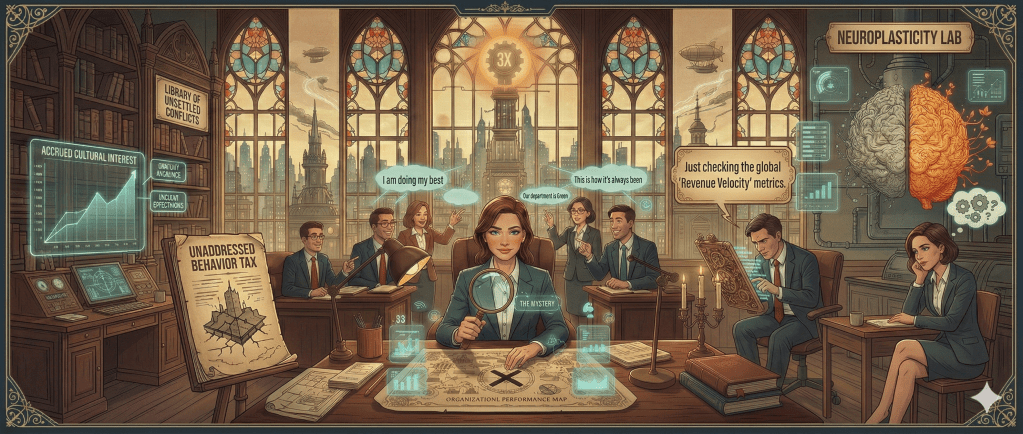
– From The Series of Serious Corporate Mysteries
Sarah sat in silence, staring at the latest company forecasts. They were going to lose more market share and miss their quarterly targets – again. She felt a churn in her stomach. “What is going on? What am I supposed to tell the board?”
Something had died inside her organization, and as the CEO, she was the one who needed to perform the autopsy. She headed to the conference room; it was time to find the killer of Performance.
The Crime Scene
During the meeting, the Head of Sales presented a 15% dip in quarterly retention. When he finished, he didn’t offer a recovery plan or a root-cause analysis. He simply shrugged. “Market headwinds and geopolitics,” he said. “We’ll try to catch up in Q4.”
Around the table, the other heads nodded in polite, sombre agreement. No one challenged the data. No one asked for a pivot. Someone passed a remark about a “disturbingly powerful political leader” impacting global industries. A few smirks and eye-rolls spread around the table—the classic symptoms of externalizing blame to avoid internal accountability.
Next, the Head of Technology presented a case for AI investments.
The CFO objected immediately: “That’s a significant budget request. We need to make the numbers look attractive for investors now. We can’t afford future-gazing.”
The CHRO intervened with a weary smile: “And let’s not forget, we still need the budget for our annual culture survey and the upcoming recruitment drive for the resources you all need.”

Sarah looked at the recruitment line item. It was bloated—millions spent on head-hunters to replace the very talent they had lost six months prior. Her eyes lit up. She heard her voice inside her own head: “We spend millions bringing people through the front door because we’re too afraid to fix the broken house they’re entering. We’re funding our own decline—this is the aftermath of our Capability Debt.”
Forty-five minutes later, Sarah saw the truth. She recalled reading about how the Balance Sheet doesn’t reflect the critical reality of human behaviour. This wasn’t just a quarterly dip. The company was headed toward a disaster fuelled by a thousand small concessions.
Performance hadn’t just died; it had been murdered in broad daylight. Who were the culprits?
The Postmortem: The Biology of Performance
To solve the mystery, we must understand the “forensics” of the human brain. Humans are biologically wired for social safety.
In a low-performance culture, the brain’s amygdala prioritizes social cohesion—”not rocking the boat”—over goal attainment. When accountability is absent, “being nice” becomes a survival mechanism that effectively silences the truth. To move from stagnation to excellence, a leader must shift the team’s internal chemistry. We must move away from high-cortisol (anxiety) or high-oxytocin (comfort) and toward a dopamine-driven cycle of achievement, feedback, and reward.
A team of behavioural and culture experts within the organization leveraged data, case studies, and insights to understand the specific issues. They pointed to 3 main culprits. Performance was killed by a Lack of Direction, Misplaced Trust, and No Accountability.
As Sarah processed this, she asked, “Can we bring Performance back to life?”
An expert from the team nodded, “Not only can you revive it, but the stakes are higher than you think. Data shows that companies who solve this ‘mystery’ see 3x the Total Shareholder Return compared to those who just ignore the shrugs.”
The Physics of Performance: Three Scientific Pillars
Building a performance culture is less about “inspiration” and more about engineering. Here are the three pillars required to keep performance alive:
1. Radical Clarity and the End of “Cognitive Fog”
We often think people fail because they aren’t working hard enough. In reality, they fail because they are exhausted by Cognitive Load. When Sarah’s team shrugged, it wasn’t laziness; it was the sound of brains stuck in a “fog” of competing priorities.
- The Solution: By providing a “Single Source of Truth” and specific, measurable directions, Sarah isn’t just managing—she is clearing the mental bandwidth her team needs to innovate. As Goal Setting Theory proves, people don’t just work for a pay-check; they work to close loops and hit marks. Take Nvidia as an example: they operate as “One Team” where the mission, not the hierarchy, is the boss.
2. The Power of “Optimal Friction” – The Yerkes-Dodson Law
Performance is not linear. According to the Yerkes-Dodson Law, performance increases with mental arousal (pressure), but only up to a point.
- Under-arousal: The “it’s not our fault” mindset Sarah witnessed. Without pressure, the engine stalls.
- Over-arousal: Look at the Goldman Sachs “100-Hour Work Week” crisis. In 2021, junior analysts revealed they were working 95+ hours weekly with near-zero sleep. The result wasn’t “elite performance”; it was a mass exodus.
- The Solution: Finding the “Goldilocks Zone”—where the bar is high enough to be challenging but supported enough to be achievable.
3. Growth Mindset and Neuroplasticity
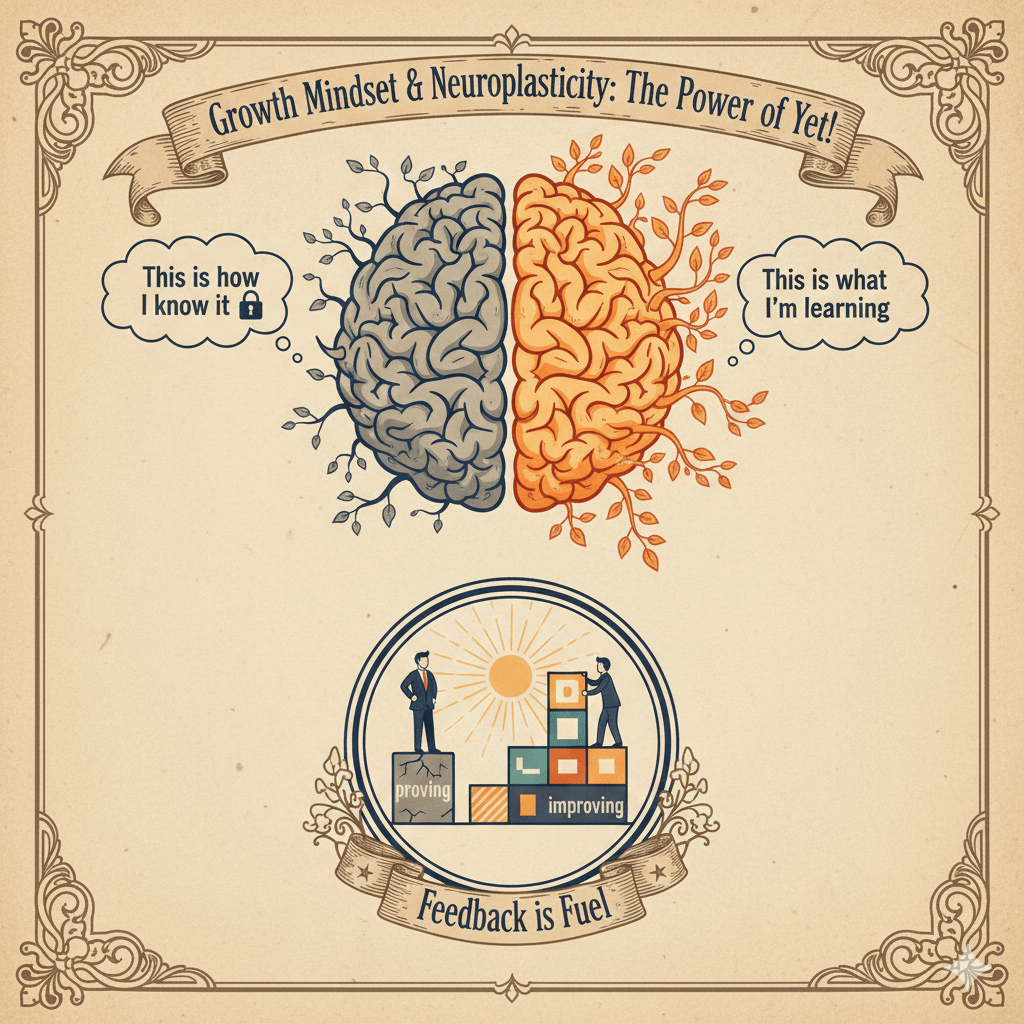
If the Fixed Mindset is the “silent killer” of performance, the solution is building a culture where feedback is fuel, not a verdict. Neuroplasticity proves that skills aren’t fixed; they are “muscles” that strengthen when we embrace challenges. Consider the turnaround of Best Buy under Hubert Joly, which serves as a definitive study in Neuroplasticity. By believing floor staff could rewire their approach—shifting from “selling products” to “solving human needs”—he revived a dying giant.
The Solution:
Use the “Power of Yet.” Instead of grading output alone, grade learning velocity. This makes it safe to be “in progress,” allowing talent to take the risks necessary for elite results.
Saving Performance: The Practical Toolkit
Sarah realized she needed to clear the “Capability Debt”—the accumulated interest of unaddressed poor behaviour. Her plan:
- Strategic Line of Sight: Strategy cannot live at the top. If a leader cannot explain how their team’s daily tasks move the needle, that role must be rethought.
- Resource the Mission: Leaders cannot demand high performance while starving the team of the capabilities, AI, tech, reward or leadership systems they need.
- Differentiated Measurement: We need to decide on the metrics of success to build the momentum towards strategic goals. With an ever increasing stream of models and tools, how does one pick the right measures and metrics?
Sarah asked the experts in her company to commit to the mission, develop a strategy, and remain accountable for the agreed-upon results. She and her team committed to driving results alongside them.
Watchout (Goodhart’s Law Warning): Remember that when a measure becomes a target, it ceases to be a good measure. So pick the meaningful ones for your “mission”. Don’t just measure “days in office”; measure “problems solved.”
The Closing Verdict: The Engine of the Future
The mystery is solved when we realize that performance is a discipline, not a feeling. The data is undeniable: McKinsey’s OHI data shows healthy, accountable cultures deliver 3x the Total Shareholder Return (TSR), and Gallup confirms a 21% boost in profitability for high-engagement units. The opportunity is greater than ever before with the possibility of leveraging AI as a Growth Ally and enhance performance further with integrated Digital Maturity.
As Sarah stood to leave, she stopped at the door. “From now on,” she said, “we stop blaming the headwinds and start adjusting our sails.” Building a performance culture is a commitment to the truth. The mystery is solved. The work begins.
———————————————————————————–
Where is your organization sitting on the Yerkes-Dodson curve: are you stalling in under-arousal or redlining toward burnout?
Is your culture budget being spent only on ‘measuring the fever’ (surveys) or ‘treating the infection’ (Capability Debt)?
How do you define ‘High Performance’ in a way that doesn’t just mean ‘More Hours’?
Let’s start the conversation!

Rajkarn Kaur Anand is a global leadership strategist with over 20 years of experience driving transformation at organizations like Maersk and Novo Nordisk. As a veteran of both Fortune 500 giants and agile start-ups, she specializes in bridging the gap between behavioral science and the balance sheet to solve the “people mysteries” that block company growth.
Raj is a firm believer that organizational health is a fiduciary duty and is dedicated to helping leaders move from “Capability Debt” to a future-ready Growth Mindset.
Connect with Raj on LinkedIn to explore how to effectively strategize and execute a Culture that enables achievement of Company Goals.
References & Scientific Validation
- McKinsey & Co | Organizational Health Index (OHI): Organizational Health is the Ultimate Competitive Advantage
- Gallup | Engagement Research: The Relationship Between Engagement and Profitability
- Cognitive Load Theory: Sweller, J. (1988). Cognitive load during problem solving.
- The Yerkes-Dodson Law: Diamond, D. M., et al. (2007). “The Yerkes-Dodson Law: A 21st Century Perspective.”
- Goldman Sachs Case: The 100-Hour Work Week and the War for Talent (BBC)
- Best Buy Case Study: Joly, H. (2021). The Heart of Business. Harvard Business Review Press.
- Goodhart’s Law: Strathern, M. (1997). “‘Improving ratings’: audit in the British University system.”
Images Note: Images created with AI may have minor spelling and other errors.
Disclaimer
This article is a part of “The Series of Serious Corporate Mysteries.” The company is fictional, and Sarah, along with all other characters, names, and incidents portrayed in this narrative, are products of the author’s imagination or are used fictitiously. Any resemblance to actual companies (living or defunct), real persons (living or deceased), or actual events is purely coincidental. The real-world corporate and scientific examples included are for educational and illustrative purposes only to provide context to the underlying organizational research.

 www.rajkarnkauranand.com
Share your Perspective. Leave a Comment.