
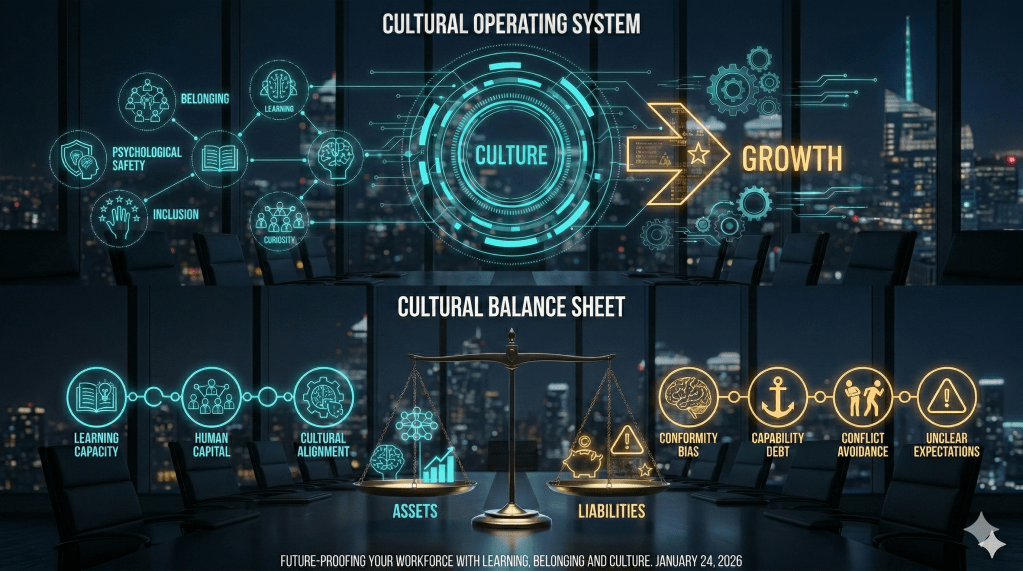
Twenty years ago, my world was defined by T-accounts, debits, and credits as I studied to find the truth in numbers. When I transitioned into the world of People & Culture, I realized that some of the most significant drivers of a company’s valuation never actually appear on the traditional balance sheet.
While a balance sheet tracks physical and financial capital, it often ignores the Human Capital that actually generates value. So, you could have an impressive balance sheet but miss out on representing some of the most critical drivers of an organization’s valuation – the intangible assets commonly called Learning, Belonging, and Culture.
1. Learning: R&D Investment
In a traditional business, R&D is an investment in future products. In a People & Culture context, Learning is the R&D of your workforce.
A culture of curiosity and continuous learning prevents “skill depreciation” in a rapidly changing market. According to the World Economic Forum, 44% of workers’ core skills are expected to change by around 2027. Does your workforce have the behavioural, functional, technological, AI, and relevant business capabilities that will be critical for your organisation to thrive through the coming years?
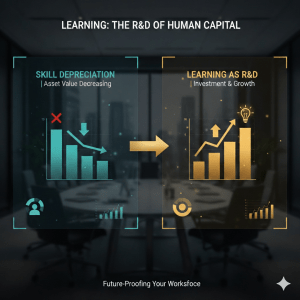
The future may seem far away, let’s get closer to the “now”. At present, many leaders are pushing for developing a “performance culture” – but they often treat learning & development as a “Period Expense.” It’s not. It is your R&D for Talent. If your people aren’t learning, your asset value is depreciating. Amazon invested $1.2 billion in its “Upskilling 2025” program. By treating learning as a strategic asset, they’ve created a pipeline that fills high-tech roles from within their existing workforce. At a wider scale, research by Bersin by Deloitte indicates that high-impact learning organizations—those that treat learning as a strategic capability rather than an expense—experience 37% higher employee productivity and are 92% more likely to innovate than their competitors.
The Bottom Line: Learning is not an expense; it is an investment into your future competitive advantage, sustainability and survival. Treating it as an investment will also create more clarity on the strategy, as well as, accountability and discipline around tracking the ROI. Just as we wouldn’t stop R&D on a life-saving drug because of a bad quarter, we cannot afford to create “Capability Debt” by pausing the development of our people.
2. The Liability of “Un-Belonging”
In accounting, a liability is an obligation. “Un-belonging”—the feeling that one cannot be their authentic self or that their contribution is capped—is a massive hidden liability. It manifests as:
- High Turnover Costs: From my network I often hear that replacing a senior leader can cost up to 2x their annual salary – especially if the urgency is high. On the other hand, research from BetterUp indicates that a high sense of belonging can lead to a 56% increase in job performance and a 50% reduction in turnover risk.
- The “Innovation Tax”: In the last 2 decades working to build culture and capabilities that drive strategy, I saw firsthand that inclusive leadership wasn’t just an HR goal—it was the ‘Safety Reserve’ that kept teams functioning during high-pressure shifts.
In cases where this psychological safety of being valued as who you are was missing, innovation stalled and performance was not optimum. This observation was backed by Deloitte’s 2023 Global Human Capital Trends report which reveals that organizations that prioritize belonging see a 17% increase in team performance and a 29% increase in collaboration.

The Bottom Line: Exclusion and Un-belonging are hidden liabilities that create a “talent drain” on your balance sheet. Critics often mistake Belonging for a “soft” comfort metric; in reality, it is a risk-management tool. It acts as a Resilience Reserve, ensuring that the “Innovation Tax”—the cost of silence and fear—doesn’t bankrupt your ability to pivot when the market demands it.
3. Culture’s Retained Equity
Equity represents ownership. When you embed purpose, inclusion, safety and growth into the core fabric of your ways of working, your employees move from “renters” to “owners”. Employees who have more ownership aren’t just performing tasks; they are investing their discretionary effort into the company’s “business dreams. To put it simply, culture is the Operating System (OS) that determines how your enterprise executes strategy
While you can’t “depreciate” a culture, you can certainly devalue it through neglect. MIT Sloan research (2022) found that a toxic culture was 10.4 times more powerful than compensation in predicting a company’s attrition rate during “The Great Resignation.”
Conversely, a Growth Mindset and Inclusive Leadership act as appreciating assets. Gartner reports that organizations with strong “Growth Mindsets” are 3x more likely to be industry leaders in innovation. Satya Nadella famously pivoted the culture of Microsoft from “Know-it-all” to “Learn-it-all.” Some may consider that this cultural shift was one of the primary drivers for their market cap soaring past $3 trillion.
The Bottom Line: Culture is the compounding interest of organizational health. Strategy sets the direction, but Culture determines the velocity. By building organizational management systems that empower people to “do their best work,” you are effectively increasing the Equity of Culture and ensuring your strategy doesn’t hit the “friction” of a disengaged workforce.
While these dimensions are not part of the Generally Accepted Accounting Principles yet, maybe it’s time to debate it – with inspiration from Goodwill, Brand Equity and other intangible assets. Steps in this direction will also help build more tangible expectations and standard measurement tools.
Watchout for Capability Budget Drainers: While not investing enough in these assets is a challenge, another challenge is when companies invest but are not strategic about it. There are ample examples of companies spending exponentially on expensive Business schools/Consultants, Content Libraries (where around 80% of the content is untouched), one-time events not connected with a larger plan, and AI based solutions. In fact, some may see AI as the ultimate silver bullet for scaling capability. In my experience, AI is a force-multiplier, not a strategy. Buying a fleet of AI coaches without a defined ‘Capability Strategy’ is like buying a high-end ERP system and entering bad data—you simply automate the depreciation of your assets at a faster rate.
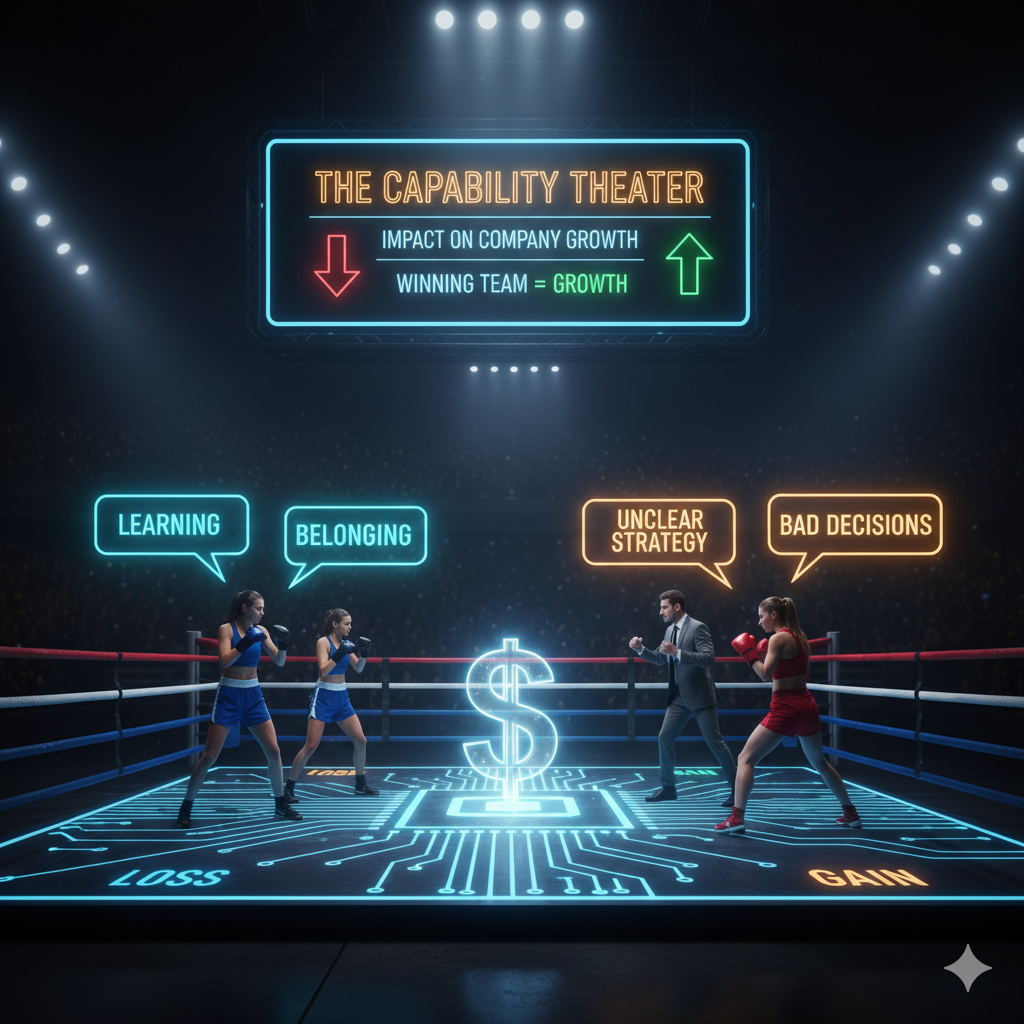
Similarly, creating a niche learning or culture solution or buying platforms without a clear and effective strategy would mainly help build the wrong skills or an expensive knowledge forum – not real applied learning or behaviour change. I’m writing a separate article to explore how to maximize returns on these spends – coming soon!
The Bottom Bottom Line: Why should we invest strategically on Learning, Belonging and Culture?
When these assets are high, the business dreams of the organization become a tangible reality. To lead in the next decade, we must start auditing the Balance Sheet of Learning, Belonging, and Culture to ensure a clear strategy and effective implementation.
Does your organization treat People & Culture as a cost to be minimized or an equity to be grown?
If yes, how will you move People and Culture from being a Cost Center to a Value Creator?
If you have already placed it (truly) strategically, how do you ensure that you are making valuable investments connected to your business needs?
Let’s start the conversation!

Rajkarn Kaur Anand is a global leadership strategist with over 20 years of experience driving transformation at organizations like Maersk and Novo Nordisk. As a veteran of both Fortune 500 giants and agile start-ups, she specializes in bridging the gap between behavioral science and the balance sheet to solve the “people mysteries” that block company growth.
Raj is a firm believer that organizational health is a fiduciary duty and is dedicated to helping leaders move from “Capability Debt” to a future-ready Growth Mindset.
Connect with Raj on LinkedIn to explore how to effectively strategize and execute a Culture that enables achievement of Company Goals.
Resources and References
- World Economic Forum (2023): Future of Jobs Report. [WEF website]. (Data on 44% skill change by around 2027).
- Bersin by Deloitte (2012/Updated 2023): “High-Impact Learning Culture: The Best Care for Managing Talent.” (Data on 37% higher productivity and 92% higher innovation in learning-centric organizations).
- Deloitte (2023): Global Human Capital Trends. (Data on 17% increase in team performance and 29% in collaboration).
- MIT Sloan Management Review (2022): “Toxic Culture Is Driving the Great Resignation.” (Data on toxic culture being 10.4x more predictive of attrition).
- BetterUp (2019): “The Value of Belonging at Work.” (Data on 56% performance increase and 50% turnover reduction).
- Gartner (2022): Report on Growth Mindset and Innovation. (Data on 3x higher likelihood of industry leadership).
- Microsoft Case Study: Satya Nadella’s “Hit Refresh” and the shift from “Know-it-all” to “Learn-it-all.” (Publicly documented in HBR and Microsoft Investor Relations).
- Images Note: Images created with AI may have minor spelling and other errors.


 www.rajkarnkauranand.com
Share your Perspective. Leave a Comment.